Key Takeaways
- With user trust falling and the need for safety growing, today’s daters crave high-quality safety tools that are not hidden behind a costly premium subscription.
- Incognito Mode and photo privacy protections are enhanced safety features that provide better protection and privacy, but only to those who can pay.
- More than half of DatingNews survey respondents said they want dating apps to improve their security standards, and 42% of surveyed women want safety features to be free.
Are dating app users being priced out of their own right to safety? It’s a question some companies would rather avoid in pursuit of profit.
Not all safety features on dating apps are available to the non-paying masses. These features have special names; they’re “enhanced,” “advanced,” and “premium,” and almost always hidden behind paywalls. They separate the privileged from the less-privileged, and put a price on safety that some daters can’t afford.
On average, most dating app subscriptions or premium tiers range from $20 to $50 a month. Hiding enhanced safety features behind premium subscription tiers may generate profits, but it can leave less privileged app users in a dangerous spot.
Scammers, catfish, traffickers, and all manner of criminals prowl even the “safest” dating apps — and quickly become the subject of headlines, podcasts, and true crime documentaries. Nowadays, online daters need all the help they can get.
After all, safety and trust are the pillars of success at any dating platform. When these pillars crumble, engagement crumbles, too. If the dater’s safety needs aren’t met by the app, they’re not going to stick around.
As the public becomes more skeptical of dating industry ethics, dating platforms must decide whether they value profits over user trust and safety.
66% of Surveyed Daters Don’t Trust Dating Apps
Daters crave safety now more than ever, because we’ve never been more aware of just how unsafe the dating world can be.
Surveys back this up: 66% of respondents in a DatingNews survey said they don’t trust apps, and 71% of Gen Z daters said they are not confident in dating app safety. A 2023 Pew Research study found 51% of women reported negative experiences on dating apps.
And those true crime documentaries we mentioned? They’ve shed a harsh light on what can happen when safety falls through the cracks on dating platforms. Pernilla Sjöholm, whose story of being defrauded on Tinder was featured in the Netflix documentary “The Tinder Swindler,” told DatingNews that dating platforms can’t afford not to prioritize safety.
“The public — especially younger generations — are already demanding safety as a priority,” she said. “The apps that fail to act now will pay the price in the near future, because the real cost of safety comes when it’s missing, and victims are left to pay it.”
Singles want to know how the industry plans to address the safety concerns the public — you know, the people who keep the industry alive — clamor for. As it turns out, meeting the safety needs of all dating app users means going beyond the basics.
Today’s most basic safety features — block and report tools, chat controls, and educational safety resources — are only free because they’ve been proven to be necessary safety tools. Then why are some “enhanced” tools only for those who can afford them?
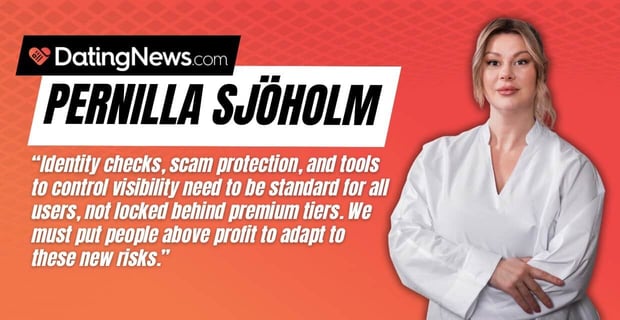
“Identity checks, scam protection, and tools to control visibility need to be standard for all users, not locked behind premium tiers. We must put people above profit to adapt to these new risks,” Sjöholm told us.
The freemium model used by most dating platforms isn’t going anywhere, but daters also aren’t going to overlook safety concerns.
Enhanced safety features may become just as necessary to everyday app safety as the block and report tool. Preserving user trust only begins when platforms prioritize safety over profit — a tall order for businesses focused on profits.
Putting Incognito Mode Behind Lock and Key
Simon Newman of the Online Dating and Discovery Association (ODDA) told DatingNews how some safety measures happen behind the scenes, without the user even knowing about them. These safety measures, such as content moderation, are usually “included free of charge.”
Naturally, the more expensive the safety measure, the more likely it will end up sitting behind a paywall.
“While the majority of dating apps offer subscriptions or premium content, approximately 20% do not, relying instead on generating income through advertising, which can be inconsistent and expensive,” Newman said. This makes putting certain features behind a paywall even harder to avoid.
Incognito Mode and photo privacy protections are two features that are normally preserved for the privileged among us.
Incognito Mode lets users explore potential matches anonymously and, in some cases, only appear to accounts they trust. Bumble, Tinder, Grindr, OkCupid, and Feeld only offer Incognito Mode as part of a paid premium plan.
In its safety handbook, Bumble says that Incognito Mode adds “another level of safety and security to your experience.” What goes unsaid is how this extra level of protection comes at a price that not every user can afford — in Bumble’s case, a premium plan costs upward of $20/month.
Young daters want platforms to help them express their sexuality while keeping private photos, well, private. But this “happy medium” can cost a pretty penny on some platforms.
Only premium-paying Grindr users have “unlimited expiring photos,” or photos that disappear from the chat as soon as they’re viewed, and cannot be saved or screenshotted. As of this writing, this feature is only available to Grindr XTRA and Unlimited users, which costs approximately $20-$40/month.
Similarly, Feeld’s Majestic Membership gives users more control over who sees their photos, which, according to the site, “Allows you to open up behind an extra layer of privacy.”
The upper echelon of dating app users enjoy other unique features, like the power to unsend messages (Grindr), and to see who likes their profile before they engage with them, which lets users easily disengage if they feel uncomfortable or unsafe based on someone’s profile (Tinder, Feeld, and Match).
Will these safety features attract paying users? Probably. But what all less-privileged users hear when they see what they’re missing out on is “Let them eat cake.”
42% Think Safety Features Should Be Free
People tend to want things they don’t have, and this includes dating safety, according to DatingNews’ survey: 41% want secure messaging with real-time flags, 38% want AI-powered scam detection, and 35% want faster background checks.
Background checks are key to the dating safety platform Tea’s popularity. The app remained popular even after two massive security breaches, and although it has since been removed from the App Store due to privacy concerns, its allure to safety-concerned daters could not be denied.
According to Pew, 60% of surveyed Americans agree that platforms should require background checks on anyone who wants to create a dating profile.
And yet, Match Group’s partnership with Garbo, a nonprofit that provided background checks to dating apps, dissolved in 2023. “It’s become clear that most online platforms aren’t legitimately committed to trust and safety for their users,” according to Garbo’s press release.
At least photo verification, once considered an “enhanced” feature, has started to become an industry standard for non-paying users, with 81% of DatingNews survey respondents supporting tighter identity verification measures.
The message is loud and clear: People are willing to jump through extra hoops during registration if it means staying safe on the apps.
Notably, 57% want to mandate identity verification for all users, whether they pay for enhanced features or not.
With safety on daters’ minds, it’s no wonder 58% of women and 53% of men told DatingNews they’d be more likely to use an app if it had enhanced security. And 42% of women believe these features should be free to all.
Some Will Pay If They Have To — But Should They?
DatingNews writer Lynn Cadet said these statistics are “a powerful signal to apps that trust can’t be paywalled.” Platforms only earn user trust when they respond to the user’s needs with actionable change — in this case, with enhanced safety features that are available to anyone.
And there’s a clear benefit to prioritizing user safety, Newman told us: “Not only does this boost confidence in the app, but it also improves retention and ultimately, profit.”
Going forward, more platforms are likely to start prioritizing safety measures earlier in the design and development process, and not just because of legislation like the Online Safety Act in the UK, for example. Consumers these days demand trust and transparency, and they want it as soon as they download the app.
As a modern matchmaking platform, Tawkify breaks the mold with its refund policy for matches that turn out to be unsafe. This is just one example of how some platforms are hearing the user’s need for trust and safety, and responding in kind.
It’s true that, as DatingNews discovered, 60% of respondents would pay for these kinds of advanced safety features. But there will always be people who can’t afford to shell out the weekly, monthly, yearly, or even one-time subscription cost.
Pew found that only 28% of those with lower incomes have paid to use a dating platform. This is a demographic of dating app users who are ready and willing to engage with dating apps so long as they have strong safety features, free of cost — or, at least, available at a more affordable price.
Separating basic safety measures from advanced safety measures puts the privileged in a safer position. The less privileged among us are already vulnerable to harassment, scamming, and exploitation; they don’t need to be harassed, scammed, or exploited while looking for love, too.
DatingNews reached out to Tawkify and Bumble to learn more about their unique user safety and anti-scam tools, but we didn’t receive a response.